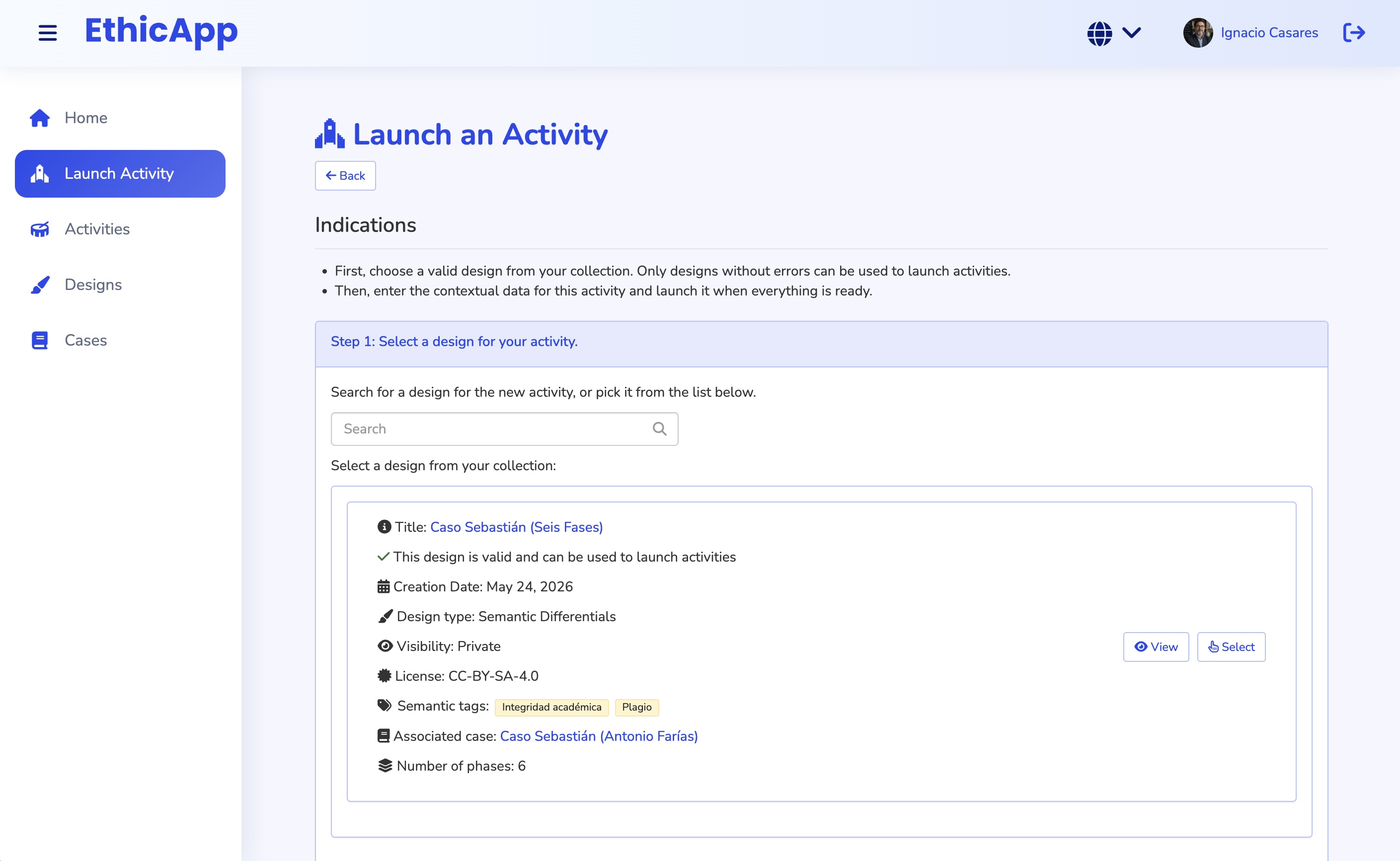
Instructional design ready to run
Case-based ethical reasoning activities can be launched in minutes using reusable templates.
EthicApp is a social platform for analyzing and discussing academic, professional, and scientific ethics cases.
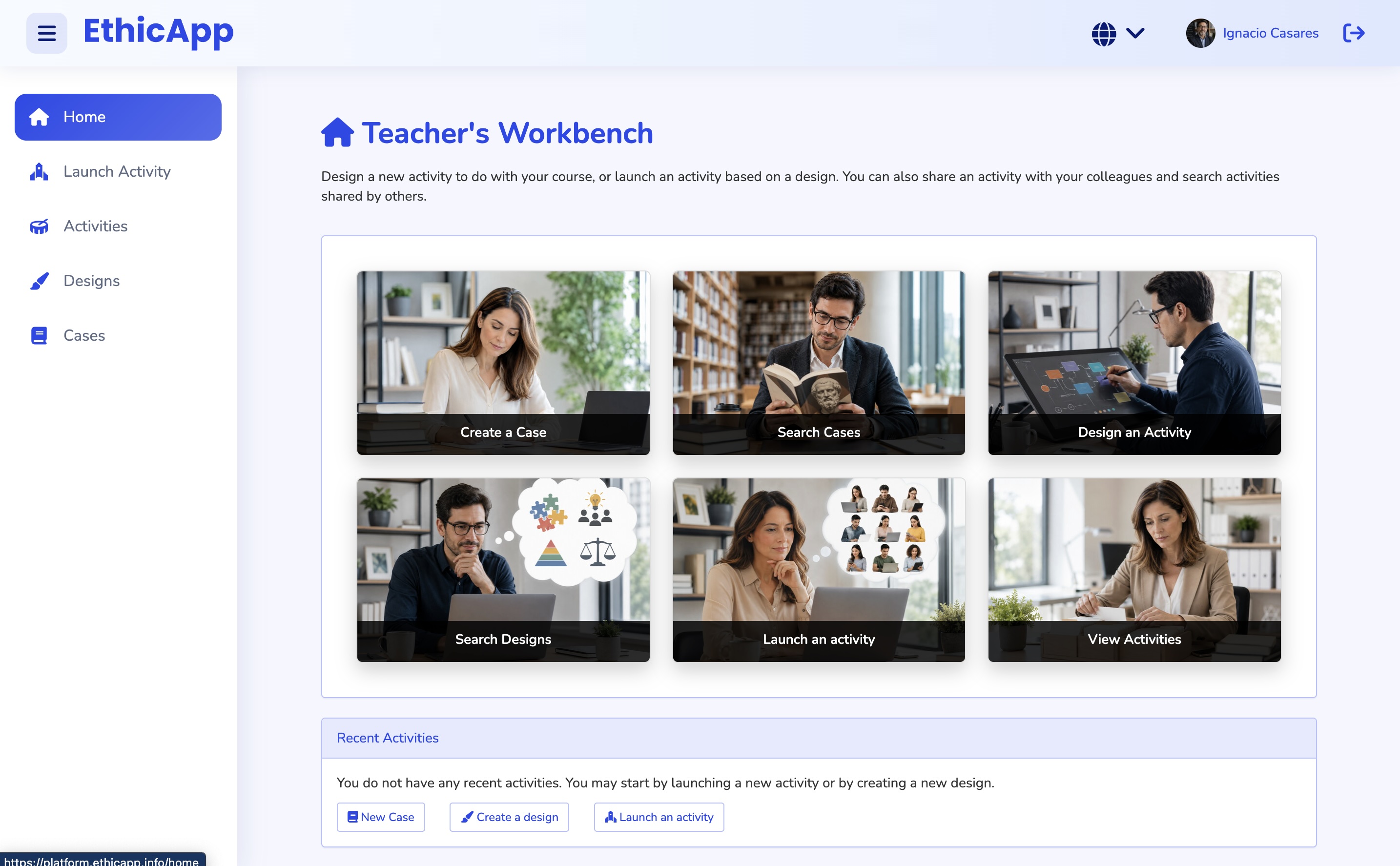
Case-based ethical reasoning activities can be launched in minutes using reusable templates.
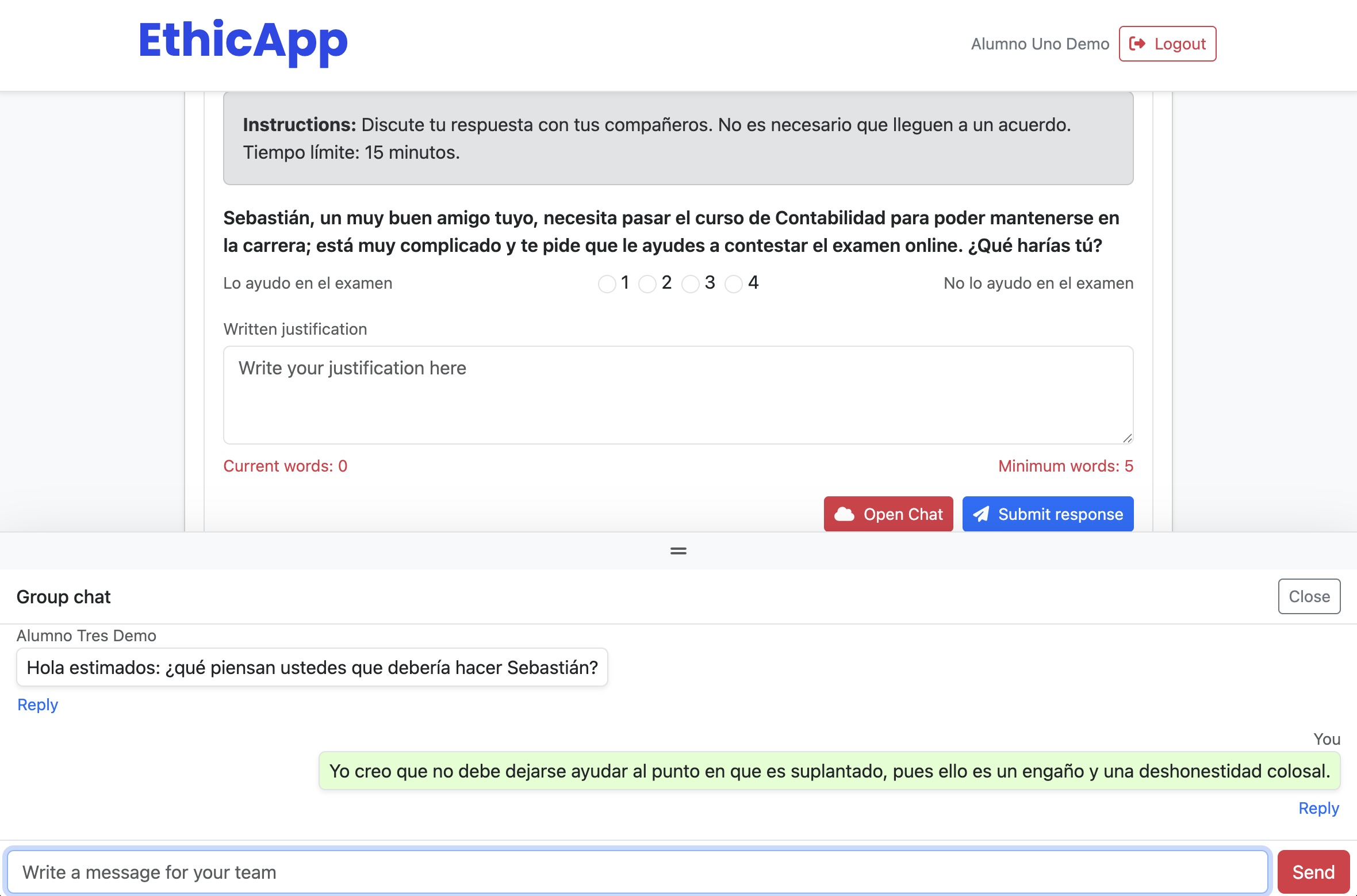
Designed for large and hybrid classes, with a simple and safe interaction model for students.
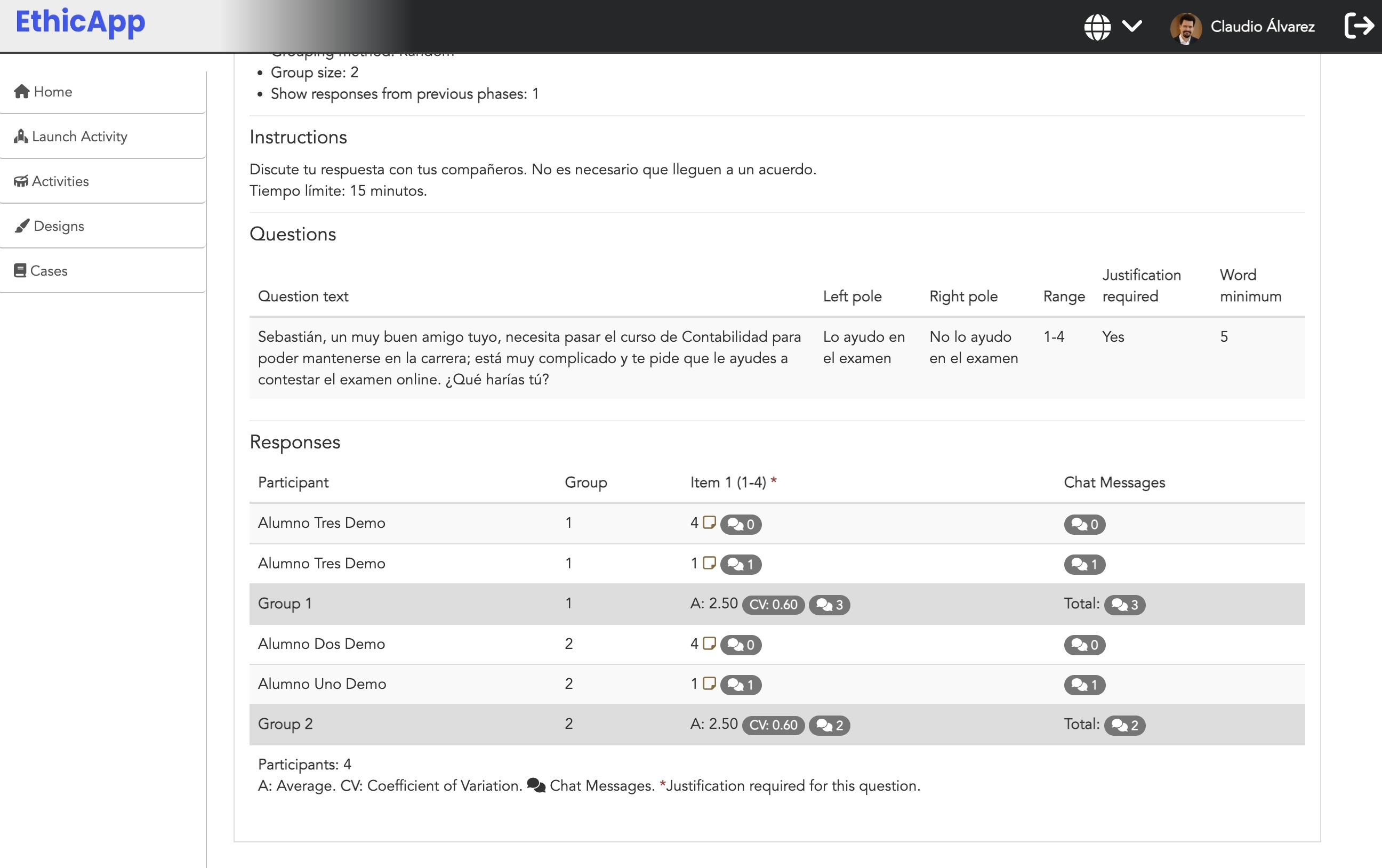
Participation traces and outcomes help instructors provide timely formative feedback.
Ready-to-run activities usable from phones and laptops.
Real-time responses and stats for better feedback.
Case sessions designed for broad and inclusive participation.
EthicApp has been implemented in higher education institutions across several Latin American and European countries. While most implementations have been with Spanish-speaking cohorts, English language is supported.

Universidad de Chile

Universidad de los Andes, Chile

Benemérita Universidad Autónoma de Puebla, México

Universidad de Cauca, Colombia

Universidad de O'Higgins, Chile

Universitat Pompeu Fabra, España

Universidad Técnica Particular de Loja, Ecuador

Universidade de Vigo, España

Universidad de Valladolid, España
Selected publications on EthicApp classroom use and related technical developments.
Bridging intuition and reason: Exploring ethical decision-making through instructional design in case-based learning
Alvarez, C., Zurita, G., & Farías, A. (2026). The International Journal of Management Education, 24(3), Article 101500.
Technology-Scaffolded Ethical Deliberation in Midwifery Education: Professors’ Reflections on a Digital Case-Based Experience
Cornejo-Moreno, M. J., Martínez-Órdenes, M., Rojas-Cáceres, C., & Barahona, C. (2026). Journal of Academic Ethics, 24(1), 51.
Desarrollo del razonamiento ético en Informática con metodologías activas apoyadas por la plataforma EthicApp
Monés, A. M., Alonso-Prieto, V., Dimitriadis, Y., Villagrá-Sobrino, S., Zurita, G., & Álvarez, C. (2025). Actas de las Jenui, 10, 133-141.
2025Ver publicación
Innovación en la Enseñanza de la Ética Empresarial usando Aplicaciones Móviles
Valenzuela-Fernández, L., Zurita, G., & Alvarez, C. (2025). Spirat. Revista Académica de Docencia y Gestión Universitaria.
Low-Footprint NLP for Reducing Teachers’ Orchestration Load in Computer-Supported Case-Based Learning Environments
Alvarez, C., Carvallo, A., & Zurita, G. (2025). Journal of Universal Computer Science, 31(13), 1463-1490.
Measurement of Teacher’s Orchestration Load: A Framework and a Case Study on Tool Flexibility
Alvarez, C., Amarasinghe, I., Zurita, G., Hernandez-Leo, D., Hakami, L., & Rojas, L. (2025). IEEE Access, 13, 39035–39050.
Exploring Group Behavior and Discussion Productivity in Anonymous Chatrooms for Ethical Decision-Making
Álvarez, C., Zurita, G., Farías, A., Yunga, M. (2024). CollabTech 2024, LNCS 14890. Springer.
Improving the Learning Experience in Ethics Education with Groupware: A Case Study
Álvarez, C., Zurita, G., Rojas, L. A. (2024). HCII 2024, LNCS 14704. Springer.
Analyzing Peer Influence in Ethical Judgment: Collaborative Ranking in a Case-Based Scenario
Álvarez, C., Zurita, G., Carvallo, A. (2023). CollabTech 2023, LNCS 14199. Springer.
Applying the concept of implicit HCI to a groupware environment for teaching ethics
Alvarez, C., Zurita, G. & Baloian, N. (2022). Personal and Ubiquitous Computing, 26, 1373–1391.
Scaffolding of Intuitionist Ethical Reasoning with Groupware: Do Students’ Stances Change in Different Countries?
Álvarez, C., Zurita, G., Farías, A., Collazos, C., González-Calleros, J. M., Yunga, M., & Pezoa, Á. (2022). CollabTech 2022, LNCS 13632. Springer.
Automatic Content Analysis of Student Moral Discourse in a Collaborative Learning Activity
Alvarez, C., Zurita, G., Carvallo, A., Ramírez, P., Bravo, E., & Baloian, N. (2021). CollabTech 2021, LNCS 12856. Springer.
A Collaborative Pedagogical Activity Design for Teaching Ethics in a Business School
Alvarez, C., Zurita, G., & Farias, A. (2021). EDULEARN21 Proceedings, 3612–3622.
A Social Platform for Fostering Ethical Education through Role-Playing
Alvarez, C., Zurita, G., Hasbún, B., Peñafiel, S., & Pezoa, Á. (2021). IntechOpen.
A CSCL script for supporting moral reasoning in the ethics classroom
Alvarez, C., Zurita, G., Baloian, N., Jerez, O., & Peñafiel, S. (2019). LNCS 11677, 62–79.

Profesor Asociado

Profesor Titular

Profesor Asociado
Open-source project under the MIT license. The applications have been developed with the nodejs and React stack, however, part of the legacy software remains in AngularJS. PostgreSQL is the database used, along with Redis for query caching. Docker compose is the preferred way for deployment. Currently, most of the development is automated using tools like OpenAI Codex and GitHub Copilot. The source code is available in the EthicApp GitHub organization.